Extracting interaction profiles#
Interaction profiles (surface point cloud, ESP on a surface point cloud, and pharmacophores) can be generated for any arbituary conformer.
import open3d # open3d can occasionally cause issues during imports; importing it first can help alleviate that
from rdkit import Chem
from shepherd_score.conformer_generation import embed_conformer_from_smiles, charges_from_single_point_conformer_with_xtb
from shepherd_score.extract_profiles import get_atomic_vdw_radii, get_molecular_surface
from shepherd_score.extract_profiles import get_pharmacophores, get_electrostatic_potential, get_pharmacophores_dict
Jupyter environment detected. Enabling Open3D WebVisualizer.
[Open3D INFO] WebRTC GUI backend enabled.
[Open3D INFO] WebRTCWindowSystem: HTTP handshake server disabled.
Get a conformer with RDKit embedding and MMFF94 optimization then obtain charges from xTB.
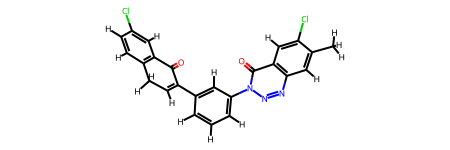
ref_mol = embed_conformer_from_smiles('c1Cc2ccc(Cl)cc2C(=O)c1c3cc(N1nnc2cc(C)c(Cl)cc2c1=O)ccc3', MMFF_optimize=True)
partial_charges = charges_from_single_point_conformer_with_xtb(ref_mol)
Extract surface#
The vdW radii and the positions of each atom is used to generate a surface. Here we sample 200 points on the solvent accessible surface with a probe radius of 1.2 A. Note that the sampling is stochastic.
radii = get_atomic_vdw_radii(ref_mol)
surface = get_molecular_surface(ref_mol.GetConformer().GetPositions(), radii, num_points=200, probe_radius=1.2)
surface.shape
(200, 3)
Extract electrostatic potential (ESP)#
The ESP at each surface point is be computed from the partial charges.
esp = get_electrostatic_potential(ref_mol, partial_charges, surface)
esp.shape
(200,)
Extract pharmacophores#
Pharmacophores are extracted using pre-defined SMARTS patterns given an RDKit Mol object. Using get_pharmacophores returns a Pharmacophore container that still unpacks as a tuple of NumPy arrays: (pharm_types, pharm_positions, pharm_vectors). get_pharmacophores_dict is a helper function that provides an easy to interpret version. Non-directional pharmacophores (e.g., hydrophobe) have vectors set to the zero vector.
get_pharmacophores_dict(ref_mol, multi_vector=False)
{'Aromatic': {'P': [(-5.581029973489963,
    1.6247950621261,
    -0.024151141926116865),
   (-0.4021173084953261, -2.44233943154787, -0.6823040596533939),
   (5.1179185937427425, 0.8516594557307537, 0.282761961403976)],
  'V': [(-0.5541088966742055, -0.5823581988013202, -0.5948296049419336),
   (-0.04509263851473645, 0.3561007265696409, -0.9333589483625007),
   (0.17308481017714678, -0.4722589632904689, 0.8642992074957333)]},
 'Acceptor': {'P': [(-2.5859750430351767,
    0.5551104613082234,
    -1.8076768473687037),
   (3.1906388531406686, -1.954764533983575, -0.905091389095362),
   (4.381762336674887, -1.5854830053066975, -0.8909336240769575),
   (1.5992883056223461, 0.6502650681542554, 0.966152057098786)],
  'V': [(0.5145138693281696, 0.3002203853457358, -0.8032080667497141),
   (-0.22559703019463873, -0.8673803236828953, -0.44357339196024276),
   (0.7087521831555617, -0.5754119146586367, -0.4081316838241143),
   (-0.6595516844244725, 0.5543684037092487, 0.5076093463892292)]},
 'Halogen': {'P': [(-6.471413689415952,
    4.129050548027996,
    -1.6478362375729725),
   (5.913840579844805, 3.566859348991792, 1.6094442355198526)],
  'V': [(-0.28703960966199465, 0.8040715550898013, -0.5206507435705419),
   (0.23973074480759482, 0.8708925721309386, 0.42903997226500207)]},
 'Hydrophobe': {'P': [(-5.581029973489962,
    1.6247950621261003,
    -0.02415114192611691),
   (-0.4021173084953262, -2.4423394315478704, -0.682304059653394),
   (5.1179185937427425, 0.8516594557307539, 0.282761961403976),
   (-6.471413689415952, 4.129050548027996, -1.6478362375729725),
   (7.911681566461128, 1.6706956301201623, 0.16907426763168465),
   (5.913840579844805, 3.566859348991792, 1.6094442355198526)],
  'V': [(0, 0, 0), (0, 0, 0), (0, 0, 0), (0, 0, 0), (0, 0, 0), (0, 0, 0)]}}
pharm_types, pharm_pos, pharm_vecs = get_pharmacophores(ref_mol, multi_vector=False)
pharm_types.shape, pharm_pos.shape, pharm_vecs.shape
((15,), (15, 3), (15, 3))
The pharmacophore types are ordered (with 0 indexing) of the following list.
from shepherd_score.score.constants import P_TYPES
P_TYPES
('Acceptor',
 'Donor',
 'Aromatic',
 'Hydrophobe',
 'Halogen',
 'Cation',
 'Anion',
 'ZnBinder',
 'Dummy')
Priority labels#
get_pharmacophores returns a Pharmacophore container that still unpacks as (types, positions, vectors). You can also mark each pharmacophore as priority (1) or not (0) from a set of atom indices. This is useful when only part of a binding site should drive downstream scoring (e.g. conditional evaluation with priority_pharm_indices).
Labeling rules
Point features (Acceptor, Donor, Halogen, Cation, Anion, ZnBinder): label
1if any contributing atom is inpriority_atoms.Aromatic and ring-derived Hydrophobe: require at least
min_ring_priority_atomsheavy ring atoms (default3) from a shared ring to appear inpriority_atoms. Usemin_ring_priority_atoms=1for looser labeling.
import numpy as np
from shepherd_score.score.constants import P_TYPES

# Eager: compute labels in one call
priority_atoms = [a.GetIdx() for a in ref_mol.GetAtoms()
                  if a.GetAtomicNum() > 1 and a.IsInRing()][:3]
pharm = get_pharmacophores(ref_mol, multi_vector=False, priority_atoms=priority_atoms)
labels = pharm.labels

# Still unpacks as the original 3-tuple
pharm_types, pharm_pos, pharm_vecs = pharm

# Inspect labels by pharmacophore type
for idx, label in zip(pharm.types, labels):
    print(P_TYPES[int(idx)], label)

# Lazy alternative: retain atom ids, then label against multiple priority sets
pharm = get_pharmacophores(ref_mol, multi_vector=False, return_atom_ids=True)
labels_alt = pharm.priority_labels(priority_atoms)
np.array_equal(labels, labels_alt)
Aromatic 1
Aromatic 0
Aromatic 0
Acceptor 0
Acceptor 0
Acceptor 0
Acceptor 0
Halogen 0
Halogen 0
Hydrophobe 1
Hydrophobe 0
Hydrophobe 0
Hydrophobe 0
Hydrophobe 0
Hydrophobe 0
True
Abstracted objects#
We introduce the Molecule object that facilitates automatic generation of interaction profiles. It holds these profiles as attributes, alongside the RDKit Mol object.
from shepherd_score.container import Molecule
The same procedure is used as above to extract each interaction profile. Note that if xTB partial charges were not supplied to Molecule, the object would compute ESP using MMFF94 partial charges which are not recommended.
molec = Molecule(ref_mol, num_surf_points=200, probe_radius=1.2,
                 partial_charges=partial_charges, pharm_multi_vector=False)
molec.surf_pos.shape, molec.surf_esp.shape
((200, 3), (200,))
molec.pharm_types.shape, molec.pharm_ancs.shape, molec.pharm_vecs.shape
((15,), (15, 3), (15, 3))
molec.mol # rdkit mol object